This is the trickiest lesson, because it asks you to do something genuinely hard: tell the difference between a real warning sign and the ordinary turbulence of being alive. You don’t want to be hypervigilant about every bad mood. You also don’t want to dismiss something that matters. So let’s build your judgment, gently.
Patterns That Deserve Attention
Communication closing down — less openness, more defensiveness, avoiding hard conversations, secretiveness. Recovery support being abandoned entirely. Stress management collapsing back into old patterns. Sleep and mood shifting noticeably, unexplained absences. Conflict rising, withdrawal from family, new friendships with concerning people. Money problems appearing out of nowhere.
One of those alone might be nothing. Several of them together start to form a picture.
When to Trust Your Gut, and When to Relax
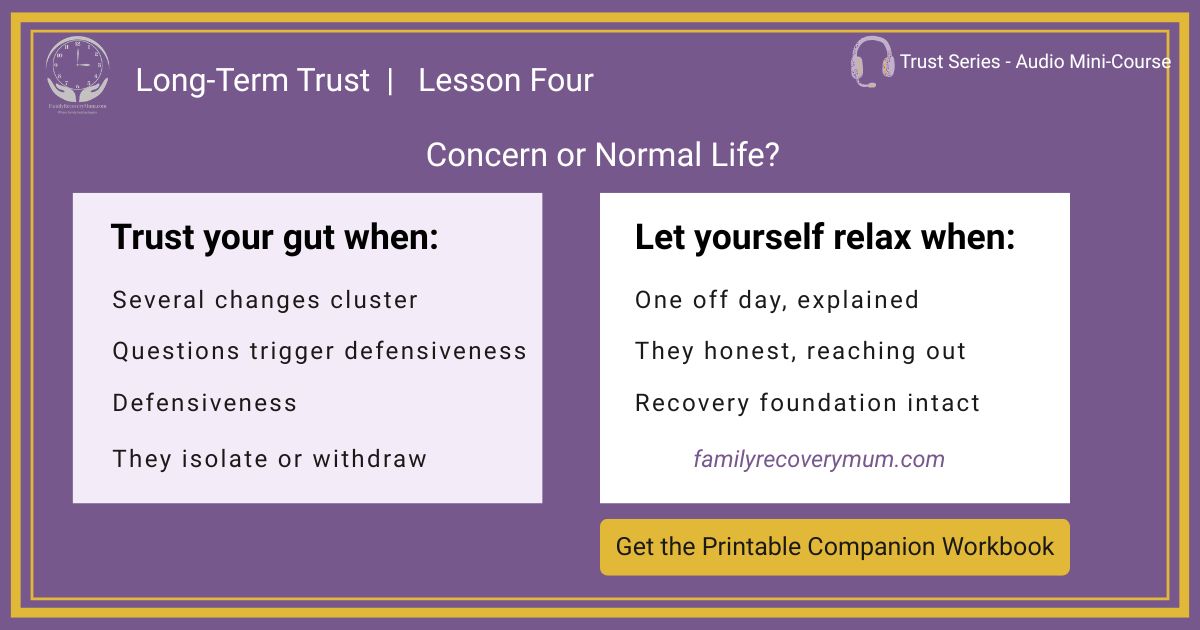
Trust your gut when you see a pattern, not a single incident — several small changes clustering together. When simple questions suddenly trigger defensiveness. And when you see isolation, because withdrawal from support is almost always worth noticing.
Let yourself relax when it’s a single off day, when the change is explained by ordinary life, when they’re being honest about a struggle and reaching for support, and when the core recovery foundation is still intact. One late night is not a relapse pattern.
The Dashboard Check
When you’re genuinely unsure, go back to the five dimensions from Core Trust and check them like a dashboard. Safety — still making safe choices? Honesty — still transparent, not defensive? Reliability — still showing up? Emotional — still regulated, conflicts handled okay? And the recovery foundation — is some support still in place?
If most of those boxes still tick, you’re likely looking at normal life; keep an eye, but don’t panic. If several don’t tick, that’s a pattern worth addressing now, not later.
Raising It as Concern, Not Accusation
A way to open it that keeps the door open:
“I need to share something I’m noticing. Over the past while, I’ve seen [the specific things]. It concerns me because of what we’ve been through. I’m not accusing you of using — I’m saying I see something that needs a conversation. What’s happening? How can I support you?”
They might get defensive — “you still don’t trust me.” You can answer, calmly: “This isn’t about not trusting you. It’s about patterns I’m seeing, and I’m raising them because I care.” They might be dismissive — “you’re overreacting.” “I hope I am. But I’m not comfortable just ignoring this.” Or they might be honest — “you’re right, I’ve been struggling.” And then your job is simply: “Thank you for telling me. Let’s work out what support you need.”
Notice that through all of this, the steady instrument is you. Your calm, your pattern-recognition, your willingness to have the gentle hard conversation — that’s the foundation doing its quiet work.
This is Lesson Four of Long-Term Trust Maintenance, Part 3 of The Trust Series. Read Lesson Three: Trust Through Life’s Big Changes → or Lesson Five: Celebrating the Journey →
Peer support from lived experience, informed by the principles of CRAFT — not a substitute for professional help.

I’m the founder of Family Recovery Mum, creating practical, compassionate resources for parents and grandparents whose loved one is struggling with addiction. You don’t have to carry it alone — and you matter too.
Faye, Recovery Mum
New here? Start with the First 48 Hours guide or explore the Free Resource Library