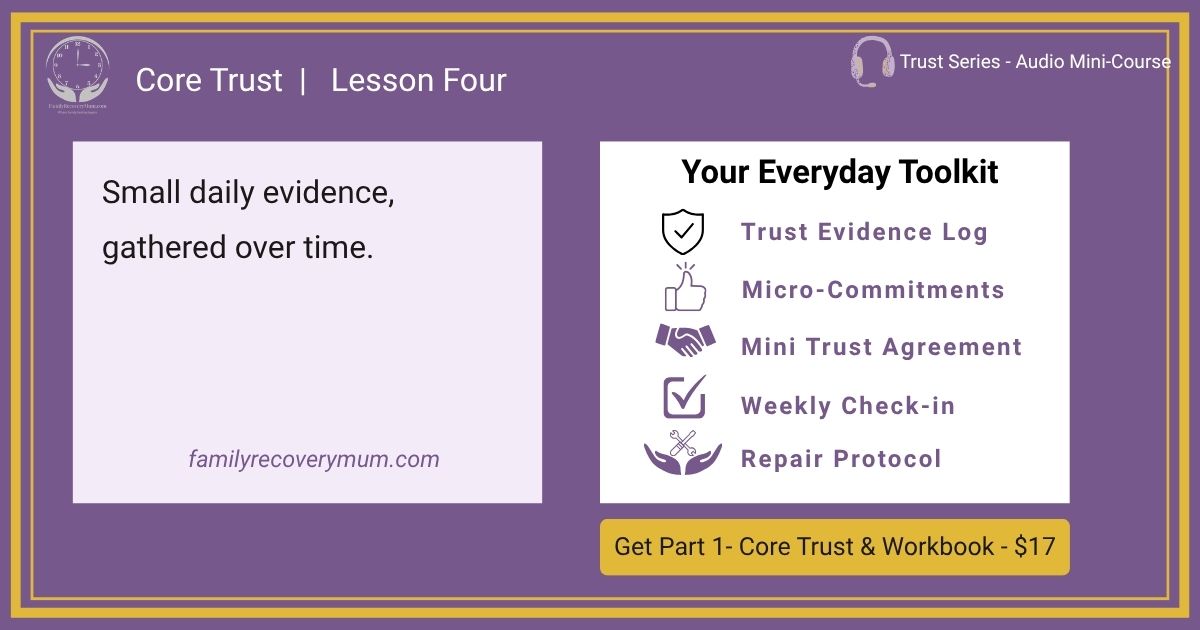
We’ve made trust something you can see — its layers, its dimensions, its phases. Now let’s bring it right down to the everyday, because this is where trust is actually rebuilt: not in big dramatic moments, but in small daily evidence, gathered patiently over time.
Here are four simple tools, and a way to hold a boundary that won’t cost you the relationship.
Four Daily Tools
A Trust Evidence Log. Each day, jot down one piece of trustworthy behaviour you actually saw. Just one. When you’re exhausted, your mind hides the progress from you — this log hands it straight back.
Micro-commitments. Tiny, doable actions — small enough to succeed, meaningful enough to count. They’re the building blocks of reliability, and they work whether you’re noticing theirs, or quietly keeping your own. “I’ll text when I leave work.” That sort of thing.
A Mini Trust Agreement. A simple, shared plan — what each of you needs to feel safe, when you’ll check in, and how you’ll repair when something slips. If you can’t fill it in together just yet, draft your side first. That’s still the foundation doing its work.A weekly check-in. Something like: “How are you feeling about your recovery this week? What’s helped? What’s been hard? And how can I best support you right now?” Four small questions, asked calmly, that keep the door open.
Boundaries Are Not Punishments
Boundaries protect the Safety dimension, and they’re so often misunderstood.
A boundary is not a punishment. And it is not an ultimatum. An ultimatum says, “You have to stop, or I’m done” — and it hands all the power to them. A boundary is different. It’s a calm decision about what you will do.
“I won’t keep alcohol in the house. If you choose to drink, I’ll ask you to do that elsewhere.”
The first you can’t enforce. The second is entirely yours to keep.
When you set one, lead with “I,” so it can be heard rather than fought: “I’m not comfortable with this. Going forward, I will do this. This isn’t about punishment — it’s about what I need to feel safe.” State it once, calmly, and then let your actions do the talking. Start with just one boundary, small enough that you can genuinely hold it.
When There’s a Setback
Setbacks happen. And a setback handled well can actually deepen trust, rather than destroy it. There are four gentle steps:
- Acknowledge what happened
- Understand the impact it had
- Explain without excusing
- Agree together on what happens next
Your Toolkit, All Together
Five dimensions to see by, four phases to find yourself in, and a small handful of daily tools — all so that you, the foundation, can keep your feet under you and rebuild trust intentionally, a little at a time.
You don’t have to use every one. And you certainly don’t have to do it perfectly. Pick one thing. Start there.
You’re doing hard, quiet, courageous work — and you’re doing it with real care.
This is Lesson Four of Core Trust, Part 1 of The Trust Series. Read Lesson Three: The Four Phases of Trust Rebuilding →
Part 1 of The Trust Series. Post-Relapse & Trust Rebuilding and Long-Term Trust Maintenance are also available now — or get all three in the Complete Bundle.
Peer support from lived experience, informed by the principles of CRAFT — not a substitute for professional help.

I’m the founder of Family Recovery Mum, creating practical, compassionate resources for parents and grandparents whose loved one is struggling with addiction. You don’t have to carry it alone — and you matter too.
Faye, Recovery Mum
New here? Start with the First 48 Hours guide or explore the Free Resource Library