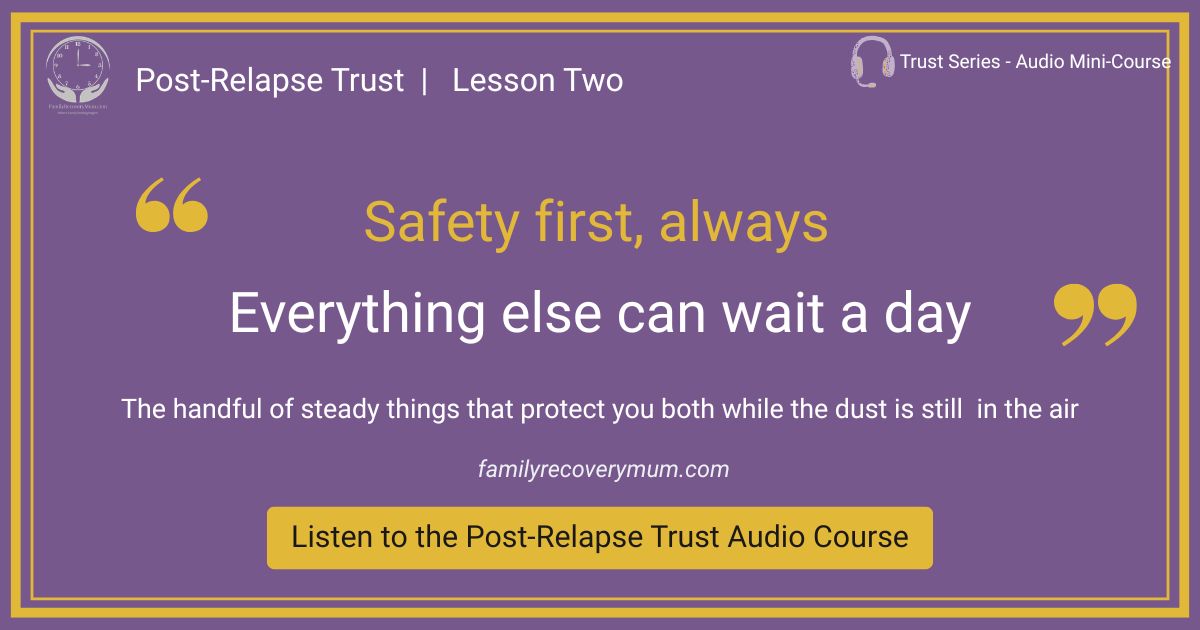
In the first days after discovering a relapse, you’re running on adrenaline and heartbreak, and it’s the worst possible state to make big decisions in. So this lesson isn’t about deciding the future. It’s about the handful of steady things that protect you and your loved one while the dust is still in the air.
What Not to Do
A few things come naturally right now, and they cost you later:
- Don’t pretend it didn’t happen — “let’s just move on” skips the grief you actually need to feel.
- Don’t trust again instantly because they said sorry — apologies don’t rebuild trust, behaviour over time does.
- Don’t catastrophise to “they’ll be using forever” — you don’t know that yet.
- Don’t take it on as your failure.
- Don’t make permanent decisions from temporary, raw emotion. You can set temporary boundaries while you process — that’s different.
What to Do
Safety first, always. Before trust even enters the conversation: are they medically safe right now — do they need detox, are they in danger? Is the environment safe — substances out of shared spaces, valuables and documents secured, children protected if that applies? And your safety — get yourself to emotional safety, call your people, try not to be alone. Everything else can wait a day.
Say the true thing out loud. Within the first few days: this broke my trust. Don’t let anyone rush you past it — not them, not well-meaning relatives, not the “relapse is part of recovery” crowd. Relapse can be common and a betrayal of trust. Both are true at once. Something like, in your own words:
“Relapse happened. I’m devastated. My trust is broken — completely broken. I need time to process this before I can even think about rebuilding. I’m not making promises right now about staying, or about trusting again. Right now, I’m protecting myself.”
That isn’t cruel. It’s honest — and honesty is the only ground any future rebuilding can stand on.
Trust goes back to Phase One. If you did Core Trust, you know the phases — and after relapse, everything returns to Cautious Hope, or even before it. The freedoms that were earned are paused. Verification comes back. This isn’t punishment, and it helps enormously to say so plainly: “This is the consequence of broken trust, not a punishment. We’re rebuilding from the foundation.”
Get professional support around everyone. A treatment reassessment for them, and just as importantly, individual support for you. Because what you’re carrying is trauma. Not “stress,” not “a hard time.” Trauma. It deserves trauma-informed care, not just a cup of tea and a brave face.
Have the foundational conversation, once the rawest edge has dulled a little. Name what happened, name that you’re starting over, and ask the one question that matters more than any promise: what is going to be different this time? Not “will you try harder” — what will actually change? That question is the whole of our next lesson.
Can I Do This Again?
Underneath all of this sits a bigger question, and I want to take the pressure off it right now: can I do this again? The honest answer, this week, might be “I don’t know.” That is a completely valid answer. You do not have to decide today. Not everyone rebuilds after relapse — some families reach their limit, and that is wise, not a failure. Some rebuild with much stricter walls. Some rebuild at seventy percent rather than a hundred. There’s no single right answer. There’s only what’s right for you and your wellbeing.
If you take one thing from this lesson: this week is for safety, honesty, and protection — not for deciding the rest of your life. The boundaries you set now are not punishment. They are the walls that keep the foundation standing while you find your feet.
This is Lesson Two of Post-Relapse & Trust Rebuilding, Part 2 of The Trust Series. Read Lesson One: Why This Breaks Differently → or Lesson Three: Rebuilding Different This Time →
Peer support from lived experience, informed by the principles of CRAFT — not a substitute for professional help.

I’m the founder of Family Recovery Mum, creating practical, compassionate resources for parents and grandparents whose loved one is struggling with addiction. You don’t have to carry it alone — and you matter too.
Faye, Recovery Mum
New here? Start with the First 48 Hours guide or explore the Free Resource Library