If you’re here, chances are you’re the one holding things together — the one who reads the room, carries the worry, and keeps showing up for someone you love who’s struggling with addiction. And you’re probably worn out, because somewhere along the way the whole family’s steadiness started resting on you.
So let’s start with the question that wears you out most: do I trust them? It feels like it should have a clean answer — yes or no, on or off. And because it never quite does, you can end up swinging between hope and dread, sometimes in the same hour.
Here’s the reframe that takes the pressure off.
Trust Isn’t a Switch. It’s Layered.
You can trust someone in one way and not in another, at the very same time — and that’s not you being confused, or unfair. That’s you seeing clearly.
You might trust they’re sober today — you can see it — and still not trust their honesty about money just yet. Both true.
You might trust they love you, and not yet trust they’ll follow through on what they promised this morning. Both true.
Holding both isn’t a contradiction. It’s an accurate map.
A mum I once spoke with told me: “I kept asking myself, do I trust him? — and the answer was both yes and no. I thought I was losing my mind.” She wasn’t losing her mind at all. She was simply noticing the truth — that trust is not one single thing.
Why This Matters Most for You
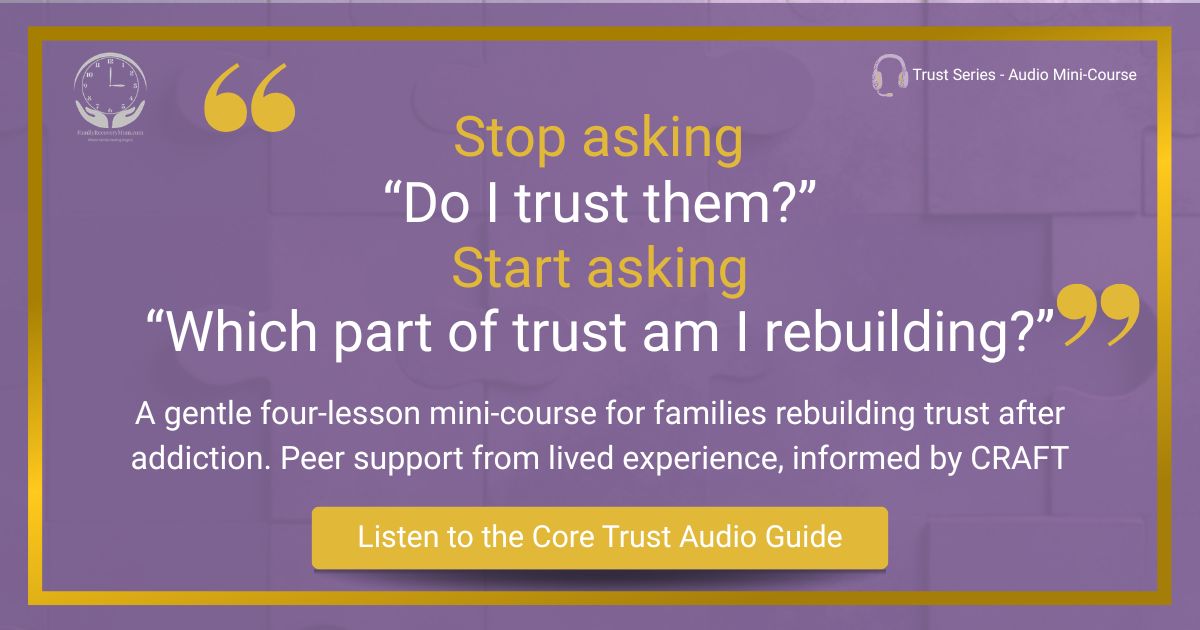
The all-or-nothing question is the one that knocks you off balance. “Do I trust them” has no footing under it. But “which part of trust am I rebuilding right now” — that you can stand on. That you can act from.
So from today, when that big anxious question rises up, gently set it down and ask the smaller, truer one instead: which part of trust is this? Is it safety? Honesty? Their follow-through?
Once you can name the part, you stop drowning in the whole.
What to Do Next
In the Core Trust workbook there’s a page called My Trust Map — a simple space to note which parts feel strongest, which feel fragile, and what evidence would help you feel a little safer. Fill it in when you’ve the energy. There’s no rush.
In the next lesson, we give those parts their proper names — the Five Dimensions of Trust — so your map gets even clearer.
This is Lesson One of Core Trust, Part 1 of The Trust Series. Peer support from lived experience, informed by the principles of CRAFT — not a substitute for professional help.

I’m the founder of Family Recovery Mum, creating practical, compassionate resources for parents and grandparents whose loved one is struggling with addiction. You don’t have to carry it alone — and you matter too.
Faye, Recovery Mum
New here? Start with the First 48 Hours guide or explore the Free Resource Library