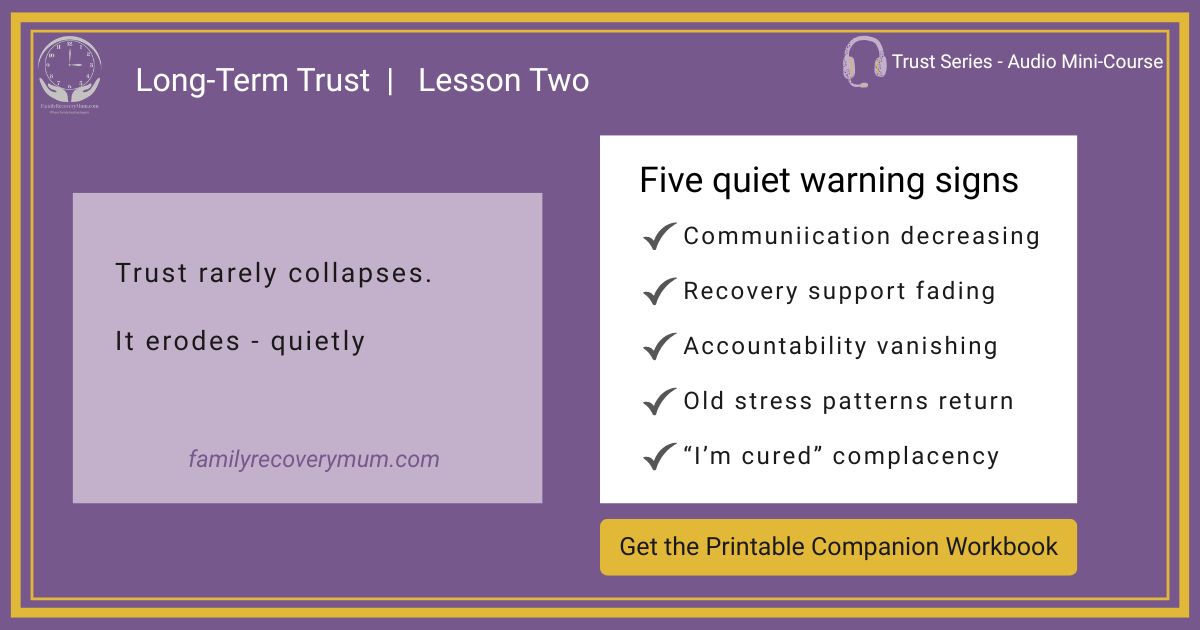
Here’s something that surprised me about long-term recovery: trust rarely collapses in some dramatic moment. Much more often, it just… erodes. Quietly. Through neglect, through complacency, through small changed patterns that nobody quite names. So this lesson is about catching that erosion early — because it’s so much easier to top trust up than to rebuild it again.
Five Warning Signs, Gently
Communication decreasing. Early on, there were daily check-ins, real conversations. Years later, assumptions quietly replace talking. “Everything’s fine” becomes the default, and weeks pass without anything meaningful being said. The danger is that when a real problem does come, there’s no habit of conversation to carry it.
Recovery support fading away. Therapy reduced, then stopped — “I don’t need it anymore.” Meetings occasional, then gone. The sponsor relationship dormant. Support naturally reduces over the years, and that’s healthy — but there’s a difference between easing off and dropping to zero. The risk of zero is that the support disappears before the stress arrives.
Accountability quietly vanishing. No check-ins, no conversations about challenges, complete independence assumed.
Stress management slipping back — not to substances, but to the old patterns: overwork, isolation, irritability, white-knuckling it alone.
Complacency itself. “I’m cured,” treating recovery as a past issue rather than a present practice. That kind of thinking tends to come before trouble, because once recovery is taken for granted, the warning signs stop being watched.
I don’t tell you these to make you anxious — the opposite. I tell you so you can do the gentle maintenance that prevents them. And the maintenance is mostly just staying in touch on purpose.
The Reframe That Helped Me Most
A monthly check-in isn’t an interrogation. It’s maintenance — like changing the oil, not waiting for the engine to fail.
“How’s recovery feeling? Any challenges lately? How’s your support? How are we doing as a family?”
Asked warmly, even when everything’s fine. Especially when everything’s fine.
Three Simple Rhythms
A monthly ritual that keeps you connected — a dinner out, a walk, a standing cup of tea, just the two of you, even when there’s nothing to discuss.
A quarterly check-in, every few months, to gently take the temperature of recovery and of the relationship.
An annual trust conversation — not because there’s a problem, but because trust, like anything precious, needs attention. “It’s been this many years. How’s trust feeling between us? What’s strong? What feels a little neglected? And when did we last stop to celebrate how far we’ve come?”
If you take one thing from this lesson: trust you don’t tend will quietly thin. A monthly cup of tea on purpose, a yearly honest conversation — small rhythms are what keep hard-won trust strong.
This is Lesson Two of Long-Term Trust Maintenance, Part 3 of The Trust Series. Read Lesson One: What Mature Trust Looks Like → or Lesson Three: Trust Through Life’s Big Changes →
Peer support from lived experience, informed by the principles of CRAFT — not a substitute for professional help.

I’m the founder of Family Recovery Mum, creating practical, compassionate resources for parents and grandparents whose loved one is struggling with addiction. You don’t have to carry it alone — and you matter too.
Faye, Recovery Mum
New here? Start with the First 48 Hours guide or explore the Free Resource Library