If you’re here, I think I know what’s happened. They relapsed. And it’s different this time, isn’t it? The first time, you didn’t know any better. This time, you’d believed. You’d rebuilt trust slowly, piece by careful piece, over months — maybe years. You’d let yourself hope. And then one phone call, one discovery, and the ground disappeared beneath you all over again.
Take a breath. The first thing I want to do is help you understand why it feels this heavy. It’s not because you’re weak. It’s because post-relapse trust is genuinely a different thing from first-time trust.
Starting From Below Zero
Think back to the very beginning, when you first learned about the addiction. You were starting from zero. Frightened, yes — but every small kept promise felt like progress, like something being built. There was no “we’ve been here before.” Hope felt allowed.
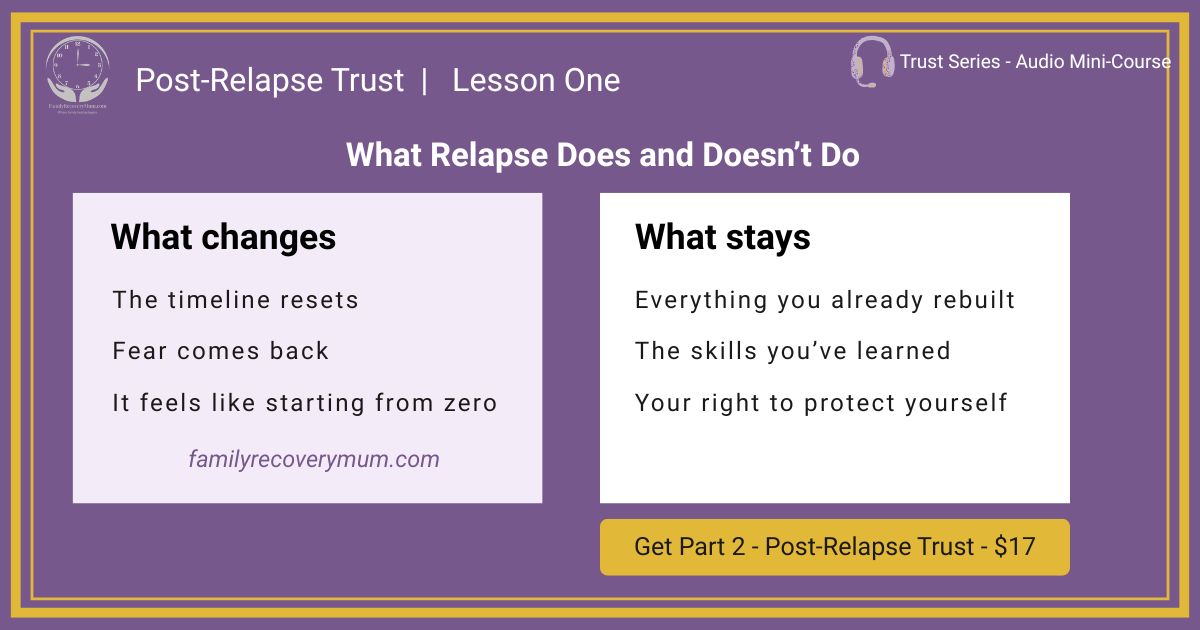
After relapse, you’re not starting from zero. You’re starting from below zero — from broken, not just absent. Every kept promise now feels like it could be performance that collapses at any moment. You’re not building trust from nothing; you’re trying to trust someone who already proved, once, that your trust could be misplaced. That is so much harder, and I need you to know it’s harder so you stop being so hard on yourself for struggling with it.
If you did the Core Trust course, you’ll remember the five dimensions — safety, honesty, reliability, emotional, and future. Here’s what relapse does: it sends all five of them back to zero at the same moment. Safety — “I thought they were safe; what else am I wrong about?” Honesty — “how long were they using while I believed things were fine?” Reliability, emotional safety, the future you’d started to picture — all of it, gone in an instant. No wonder you feel like the floor vanished. Five floors vanished.
The Thoughts That Come Looking for Someone to Blame
So your mind goes looking for someone to blame, and it usually lands on you. I missed the signs. I trusted too soon. I can’t trust my own judgment anymore. Or it swings the other way — they lied to my face, they’ll never change. Or it turns on the whole family — we’re broken, recovery isn’t possible for us.
Here’s what I want you to hear about those thoughts: they are normal. Every single one of them is a normal grief response to relapse trauma. But they are not the truth. They’re pain wearing the costume of truth.
You did not cause the relapse. You could not have controlled it. And needing to protect yourself now is not a character flaw — it’s wisdom catching up with your heart.
Your Permission
So here is your permission, and I mean every word. You are allowed to be devastated. You are allowed to be furious. You are allowed to question everything. You are allowed to take time before you decide whether you can do this again. You are allowed to have stricter boundaries than before, to need more evidence this time, to trust more slowly — and yes, you are allowed to never trust at a hundred percent again.
None of that makes you cold. It makes you someone protecting the foundation — and right now, the foundation is you.
For now, just let this lesson be permission to fall apart a little. That’s allowed too.
This is Lesson One of Post-Relapse & Trust Rebuilding, Part 2 of The Trust Series. Read Lesson Two: The First Week →
Peer support from lived experience, informed by the principles of CRAFT — not a substitute for professional help.

I’m the founder of Family Recovery Mum, creating practical, compassionate resources for parents and grandparents whose loved one is struggling with addiction. You don’t have to carry it alone — and you matter too.
Faye, Recovery Mum
New here? Start with the First 48 Hours guide or explore the Free Resource Library