We’ve named why this break is different, steadied the first week, and learned to look for real change. Now we protect you — because rebuilding trust after relapse means staying open to connection while keeping yourself safe, and that’s a delicate balance to hold.
Trust Today, Not Tomorrow
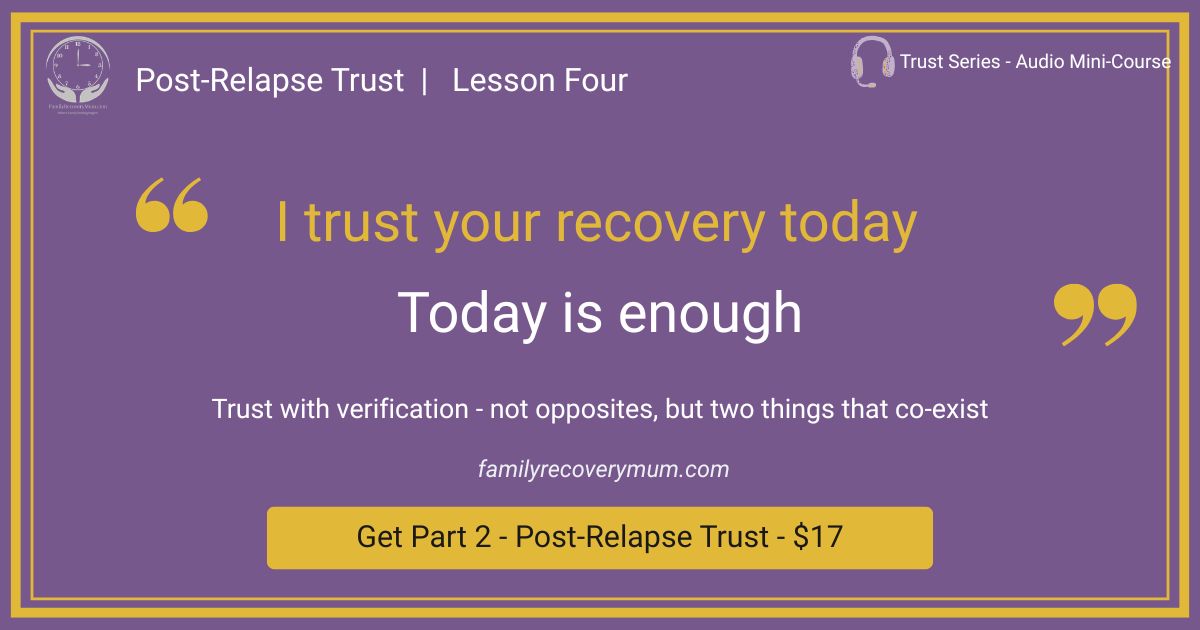
“I trust your recovery today. I believe in your sobriety right now. I’m not making assumptions about next month or next year. Today is enough.”
That lets you trust the present without needing certainty about a future nobody can guarantee.
Trust With Verification
These are not opposites. After relapse, they coexist. “I trust you’re going to therapy, and I’d like confirmation from your therapist. I trust you’re staying sober, and we’re keeping the testing in place.” Both true at once. And that verification may last longer than it did first time — maybe much longer. That’s not punishment. It’s protection you earned the hard way.
Here’s something real that helped one family I know. When they were rebuilding after a relapse, they bought a simple breathalyser. Every morning and every evening, she’d blow — live, with that day’s date showing on the screen beside her, so everyone could see it was today’s reading, not yesterday’s. It sounds clinical written down. It wasn’t, in the room. It gave her partner and her family a way to trust — not forever, not a promise about next year, just today. And on the hardest days, today was enough to hold onto. The thing that made it work was that they talked it through with her first, and she was completely on board — something done together, not done to her. That small daily ritual gave the certainty everyone needed to go back to living their own lives again — a partner who could leave for work without a knot of worry in his chest, a mum who could step back and go back to being a mum instead of a monitor.
That’s what verification is really for. Not to catch someone out — to give everyone enough safety to breathe. And like all this scaffolding, it can ease as trust rebuilds.
Trust the Dimensions Separately
You don’t have to trust all five at the same speed. You might fully trust their safety and honesty while keeping your deepest emotional vulnerability held back a while longer. “I trust you’re sober and being honest about your days. I don’t yet trust you with my whole unguarded heart. Both of those are okay.” That stops the all-or-nothing thinking that makes trust feel impossible.
Some emotional walls might stay up permanently after relapse — and I want to be really clear, that is self-care, not withholding love. “I love you. I support your recovery. And I’m also protecting my heart — some walls stay up longer this time.” You can have a close, loving relationship while keeping a part of yourself protected.
On Forgiveness
Families ask me whether they have to forgive, bracing for me to say yes like it’s a duty. Here’s how I’ve come to see it. Forgiveness, the kind I mean, isn’t saying what happened was okay. It isn’t dropping your boundaries or pretending the wound wasn’t real. It’s setting down the part of the resentment that’s only hurting you — the replaying at 3am, the bitterness you carry into rooms they’re not even in. In that sense, forgiveness is a form of protection. It protects you, not them. You can keep every wise boundary and choose to stop letting the betrayal live rent-free in your body.
The Eighty-Five Percent
Trust after relapse may never go back to a hundred, and I’d like to take the grief out of that for you. The fifteen percent you hold back isn’t mistrust of them as a person — it’s realistic awareness that addiction is chronic. It’s protective wisdom. It’s caution earned through experience. You can have a genuinely good, warm, meaningful relationship at eighty-five percent. That missing fifteen isn’t a failure to forgive or a refusal to heal. It’s the wisest part of you, keeping the foundation safe.
So if you remember nothing else, remember this: wariness isn’t pessimism — it’s realism that’s been through something. Boundaries aren’t punishment — they’re protection. And your healing matters as much as their recovery. Not after it. As much as it.
Because here is where we end, the same place we began. You are the foundation. So tend yourself. Get the trauma support. Keep your own life and your own people. Plan for the worst quietly so you’re free to hope for the best.
Trust after relapse looks different. It feels different. It is different. And it can still be real, and meaningful, and good. One day at a time. One piece at a time. With appropriate protection and realistic hope.
This is Lesson Four of Post-Relapse & Trust Rebuilding, Part 2 of The Trust Series. Read Lesson Three: Rebuilding Different This Time →
Part 2 of The Trust Series. Core Trust and Long-Term Trust Maintenance are also available now — or get all three in the Complete Bundle.
Peer support from lived experience, informed by the principles of CRAFT — not a substitute for professional help.

I’m the founder of Family Recovery Mum, creating practical, compassionate resources for parents and grandparents whose loved one is struggling with addiction. You don’t have to carry it alone — and you matter too.
Faye, Recovery Mum
New here? Start with the First 48 Hours guide or explore the Free Resource Library