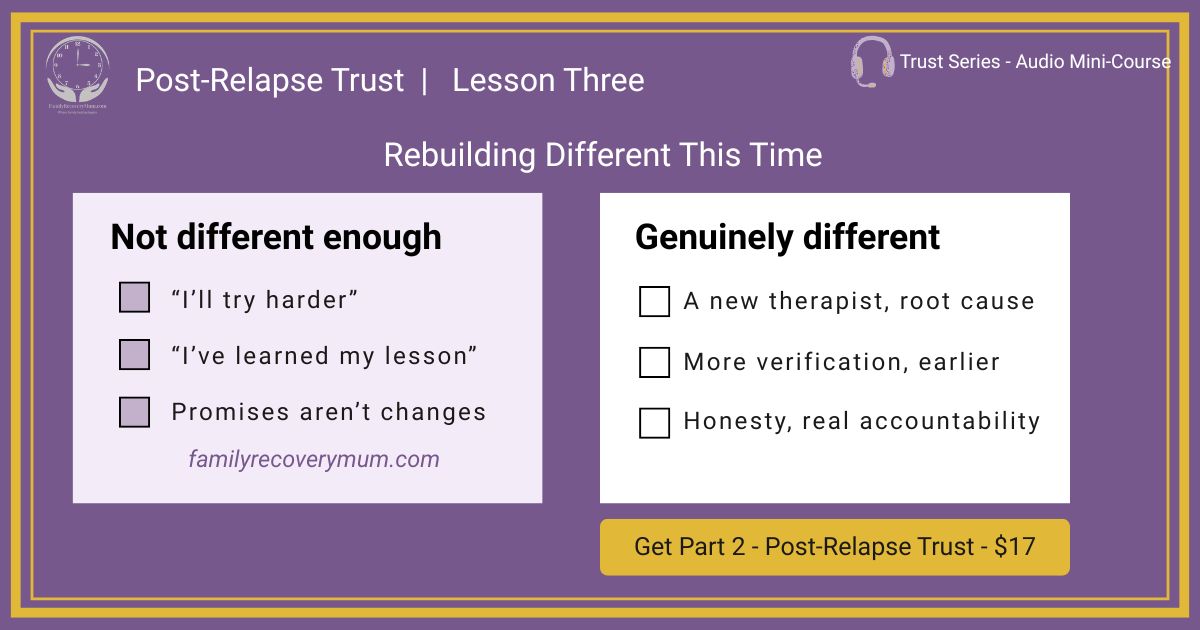
This is the hinge of the whole course, and it comes down to one question: what is actually different this time? Because here’s the hard truth — you cannot rebuild trust on the same foundation that already failed. If nothing real has changed, the risk is still high, and rebuilding trust now would only set you up to be hurt again.
So let’s learn to tell the difference between change that’s real and change that only sounds like it.
What Isn’t Different Enough
“I’ll try harder.” “I won’t let it happen again.” “I’ve learned my lesson.” “I really mean it this time.”
I know how much you want to believe those. But they’re promises, not changes — and promises didn’t prevent relapse last time. Same therapist, same meetings, same coping tools that already didn’t hold, same stresses that contributed last time — if the system didn’t work before, repeating it won’t work now.
What Genuine Difference Looks Like
Clinical changes. A different therapist if the old approach missed the root. Trauma therapy that goes after causes, not just symptoms. Medication if brain chemistry needs the support. A more intensive level of treatment than before.
Behavioural changes. Actually addressing what caused the relapse. New coping mechanisms being practised. A high-risk relationship or living situation actually ended, not just talked about.
Relational changes. Honesty about struggles coming earlier this time. Less defensiveness about being monitored. And — this one matters — them actually acknowledging your trauma, not just their own recovery.
Accountability changes. More frequent check-ins than before. More verification. A third party, like a sponsor, in the picture. A written relapse-prevention plan with an early-warning system you both understand.
When I think about what convinced me rebuilding was even worth attempting, it was a list: a new therapist who actually specialised in the underlying trauma, medication for the anxiety that had been there untreated the whole time, a relationship that had been quietly feeding the using finally ended, and a level of honesty, earlier, that simply hadn’t existed the first time round. Without changes like those, I wouldn’t have been willing. The list is what earned my willingness — not the apology.
The Timeline Trap
There’s one more trap I have to warn you about, because almost every family hits it: the timeline trap. After relapse, you become hyper-aware of timelines. If they relapsed at fourteen months last time, then fourteen months this time feels unbearable. You can’t eat, can’t sleep, you’re holding your breath waiting for history to repeat.
That fear is normal — it’s not paranoia, it’s your brain doing pattern recognition, trying to protect you by flagging “last time, this is when it fell apart.”
What helps is to say it out loud rather than carry it alone: “We’re coming up to the timeline when it happened before. I’m frightened. This isn’t about not trusting you today — it’s my body remembering.” Then look hard for what’s actually different at this point compared to last time. Were they isolating, out of therapy, hiding stress last time — and now? If the answer is genuinely different, that difference is your evidence. Make new markers, too: not just “months sober” but “months in trauma therapy,” “months being honest early.” Different foundation, different count.
The question to keep returning to isn’t “are they sorry?” It’s “what is concretely, demonstrably different — and is it enough?”
This is Lesson Three of Post-Relapse & Trust Rebuilding, Part 2 of The Trust Series. Read Lesson Two: The First Week → or Lesson Four: Protecting Yourself While You Rebuild →
Peer support from lived experience, informed by the principles of CRAFT — not a substitute for professional help.

I’m the founder of Family Recovery Mum, creating practical, compassionate resources for parents and grandparents whose loved one is struggling with addiction. You don’t have to carry it alone — and you matter too.
Faye, Recovery Mum
New here? Start with the First 48 Hours guide or explore the Free Resource Library