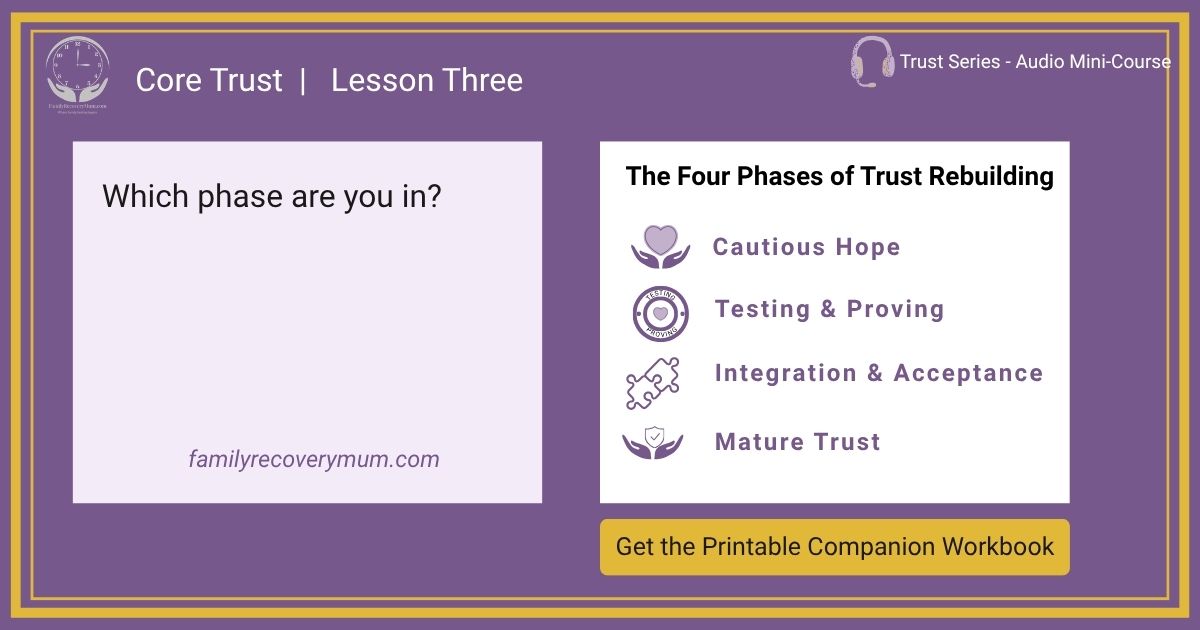
We’ve looked at the layers of trust, and its five dimensions. Now let’s talk about time — because trust doesn’t rebuild in a straight line. It moves through phases, and each one has its own feel.
Phase One: Cautious Hope
This is where trust begins again, but only in small, fragile ways. You’re hopeful — but guarded. You’re watching closely, and you feel a little braced.
I want you to hear this: that watchfulness is not paranoia. In this phase, it’s exactly right. It’s appropriate, and it’s necessary.
Phase Two: Testing and Proving
Phase Two: Testing and Proving
This is where you start to see whether the behaviour holds. You’re looking for patterns now, not promises — watching how they handle an ordinary stressful day, a trigger, a disappointment.
This phase takes a while. And it’s meant to.
Phase Three: Integration and Acceptance
This is where trust begins to feel more natural again. You notice you’re not checking constantly. You’re not bracing for bad news every time the phone rings. You start, cautiously, to believe in the steadiness of their recovery.
Phase Four: Mature Trust
This is the long-term kind — realistic, grounded, resilient. It isn’t naive, and it isn’t on permanent high alert either. It’s a trust that knows addiction is a chronic thing, and also knows recovery can be stable and real.
Two Honest Things About These Phases
You don’t move through them quickly, and you don’t move through them neatly — there’s no gold star for speed.
And after a relapse, you may find yourself back in an earlier phase — and that is not starting again from zero. You carry everything you’ve learned with you.
The Gift in Naming Where You Are
When you can name the phase you’re in, you stop feeling lost. You stop asking, “Why am I still so anxious?” or “Why aren’t I further along?” You realise trust has a timeline of its own — and you, the foundation, are allowed to be exactly where you are, today.
In our final lesson, we bring it all down to the everyday — the daily tools, the boundaries that protect your safety, and the way back when there’s a setback.
This is Lesson Three of Core Trust, Part 1 of The Trust Series. Read Lesson Two: The Five Dimensions of Trust → or Lesson Four: Daily Trust, Boundaries & Setback Repair →
Get Core Trust — 4 audio lessons, full transcripts, and a companion workbook — $17 →
Peer support from lived experience, informed by the principles of CRAFT — not a substitute for professional help.

I’m the founder of Family Recovery Mum, creating practical, compassionate resources for parents and grandparents whose loved one is struggling with addiction. You don’t have to carry it alone — and you matter too.
Faye, Recovery Mum
New here? Start with the First 48 Hours guide or explore the Free Resource Library